The dancer behind the museum
Cristina Hoyos and her museum
Who Cristina Hoyos is, how a Seville dancer became a film star and company director, and why her name sits over the Museo del Baile Flamenco.
Book your flamenco night ↗A dancer from Seville
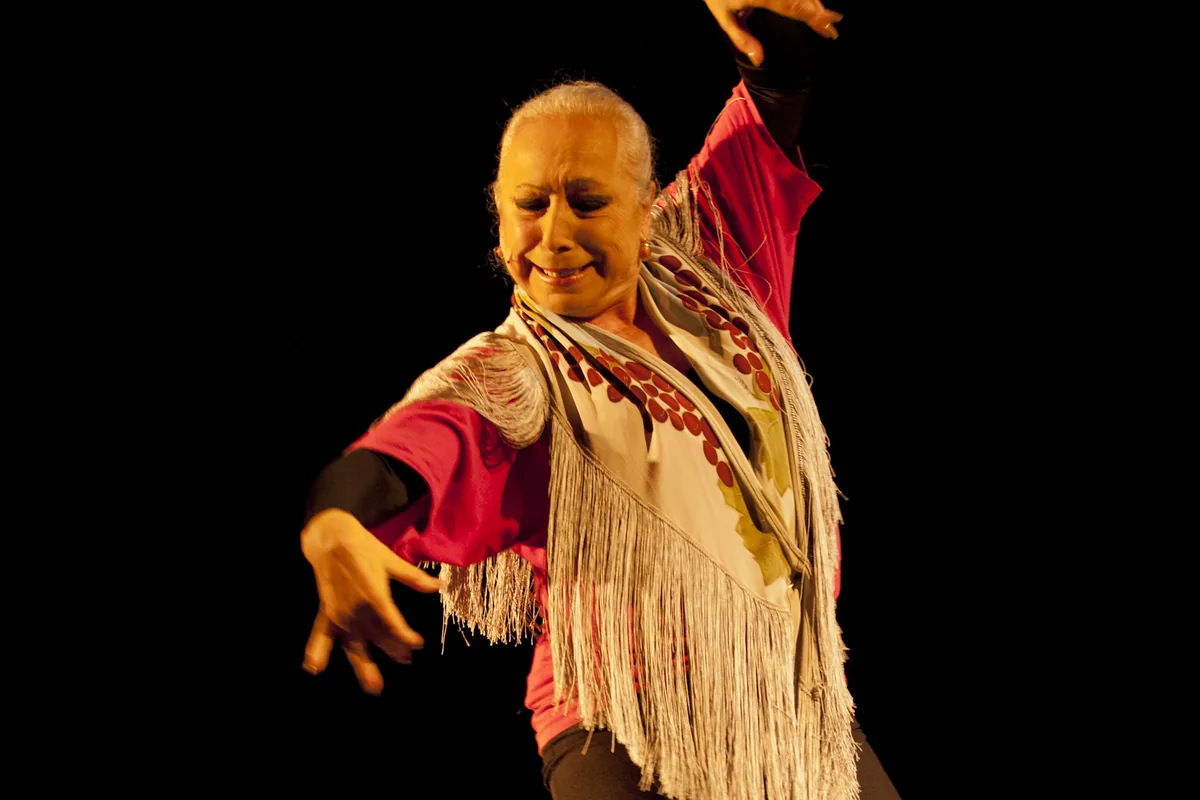
Cristina Hoyos was born in Seville in 1946. According to Wikipedia, she began dancing at twelve in a children's show called Galas Juveniles, and two teachers, Adelita Domingo and Enrique el Cojo, fed her passion for the art. Seville is also where the museum stands, and the museum's own history quotes her saying that a museum in her city would give back to flamenco dance what the dance had given her.
Years with Antonio Gades
In 1969 she joined the ballet company of Antonio Gades and stayed for more than twenty years, touring the world. During those years she starred in three films directed by Carlos Saura: Blood Wedding in 1981, Carmen in 1983 and El amor brujo in 1986. In 1983 she danced Carmen in the Gades ballet in Paris, where, Wikipedia says, her performance received rave reviews. The museum shows paintings and photographs of that period, which connect to what you see in the galleries.
Her own company
In 1988 Hoyos opened her own dance company, which premiered at the Rex Theatre in Paris. A year later it debuted Sueños Flamencos at the 1989 Paris Festival, and in 1990 she took the show to the Paris Opera House, where her flamenco company was the first of its kind on that stage. She repeated the feat at the Stockholm Opera. She also appeared in the opening and closing ceremonies of the 1992 Barcelona Olympics, and performed at Expo '92 in Seville.
How the museum began
The museum's own history says the idea arose in 2001 and was put to Hoyos by two collaborators. She liked it because, unlike another school, a museum in her own city would give flamenco dance back what it had given her. The team spent more than four years developing it, found an 18th-century house near the Cathedral, and opened its doors in April 2006. The same history calls it the first and only museum in the world devoted to flamenco dance.
Her seal on the stage
The museum says every choreography performed on its stages carries Hoyos's quality seal, and the booking page describes the show as choreographed by her. The performers change daily, so what stays constant is the standard she sets, not a fixed cast. Her name also appears on the building: the full title is Museo del Baile Flamenco Cristina Hoyos. A museum news item from December 2025 notes that she had been named godmother of an international flamenco festival.
Her work on the museum's walls
The museum's permanent collection lists many works that picture her and her contemporaries. Paintings by Jean Lamouroux show rehearsals and performances of Carmen, the wedding and the rumba, with Hoyos and Gades among the figures. Photographs by Oscar Balducci record productions from the 1970s and early 1980s, including Bodas de Sangre in 1974 and Suite Flamenca in 1981. Other artists, among them Miguel Alcalá and Marvin Steel, contributed portraits of Hoyos and her fellow dancers. These works are in the galleries, not on the show stage.
Prizes and recognition
Wikipedia lists a long run of honours. In 1991 she received Spain's National Dance Prize and the Gold Medal of the City of Seville. In 1993 she won the Gold Medal for Fine Arts from the Spanish government, and in 1997 France made her a Knight of the Order of Arts and Letters. Between 2005 and 2008 she received the Andalusia Tourism Prize, naming her Ambassador of Andalusia. For a visitor, the point is simple: the name over the door belongs to one of flamenco's best-known dancers.
Sources